Appearance
Graph View
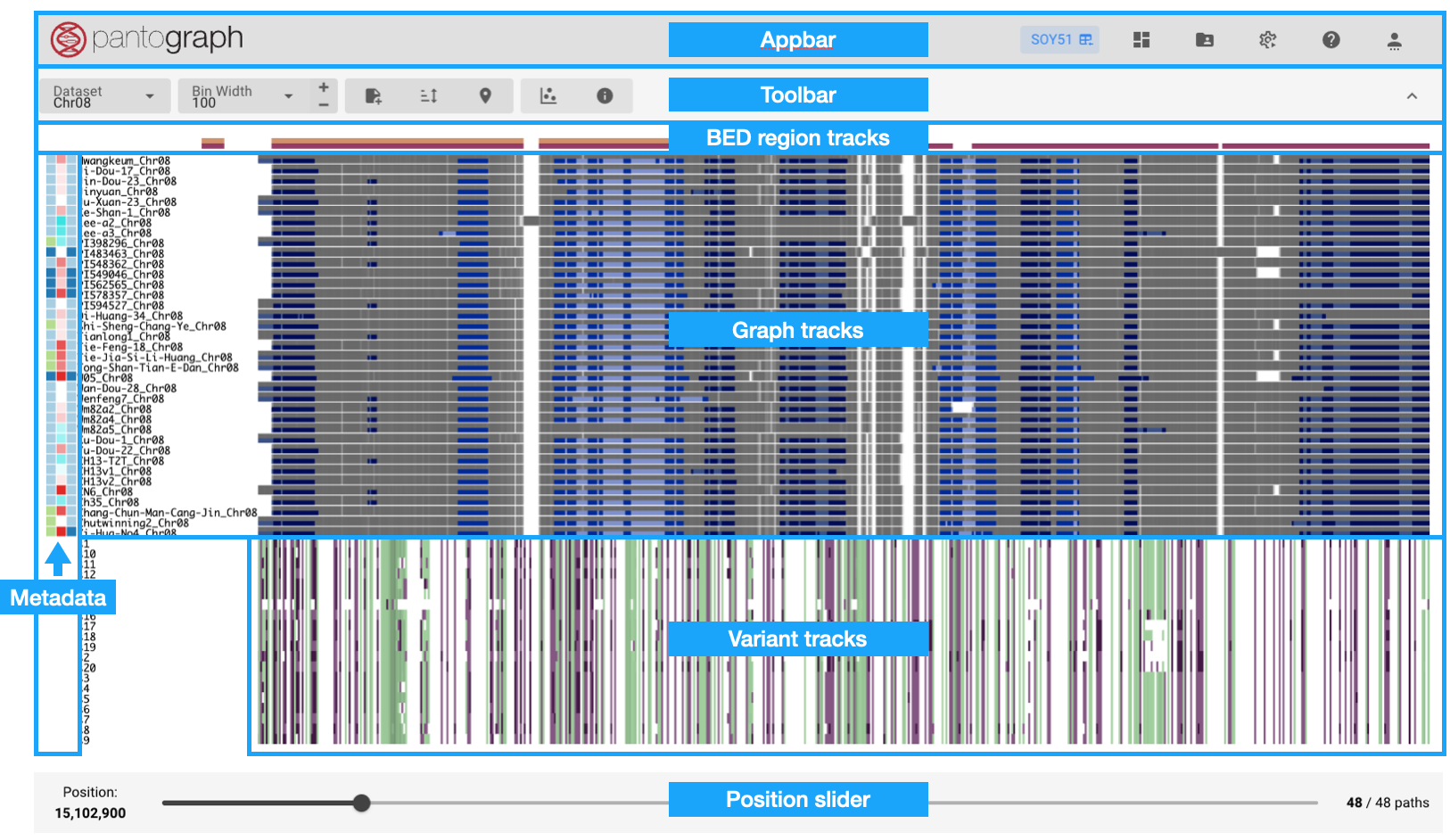
This page displays the chromosome-specific pangenome graph. It is divided into following parts:
- Pantograph logo: clicking opens the Genome View
- Appbar
- Toolbar
- Tracks: Graph, variant, and BED region/QTL tracks
- Metadata heatmaps
- Position slider: start position of the current view in the pangenome graph
Appbar
The following pages can be accessed in the appbar on the very top of the page:

Toolbar
The toolbar offers these functionalities from left to right:

Dataset: navigate to a chromosome-specific pangenome graph
Bin width: select the zoom level
Tracks Menu: (de)select all data displayed along the pangenome — tracks (graph and variant tracks), metadata, QTL tracks and BLAST hits Sort Menu: sort graph and variant tracks separately by metadata values or by name, in ascending or descending order Navigation Menu: navigate to genome-specific coordinates or to genes by name (partial match) Plot Menu:- Interactive PCA plot (if available)
- Tree Window to browse cluster dendrograms or pre-computed phylogenetic trees
Tracks
There are four different kind of tracks:
- Graph tracks: Show the aligned genomic sequences from the pangenome graph
- Variant tracks: Show variant calls from vcf files anchored to paths in the pangenome
- QTL tracks: Show QTL regions along the pangenome
- BLAST tracks: Show the hits of selected BLAST pipelines along the pangenome
All of them are (de)selected in the Tracks Menu.
Metadata
Any available meta data associated with each path is displayed as one vertical heatmap per meta data category in front of each row. Meta data can be traits like flowering time, maturity, yield, etc., a haplotype identifier or other categories (e.g. cultivation type, provenance). Categorical as well as quantitative (integer or floating point numbers) are supported and automatically identified.
Tracks can be sorted by metadata categories via the dropdown menu in the toolbar or by clicking small arrows on top of each metadata heatmap. Each repeated click reverts the sort order.
Metadata can be uploaded/updated by admin users.
Tracks Menu
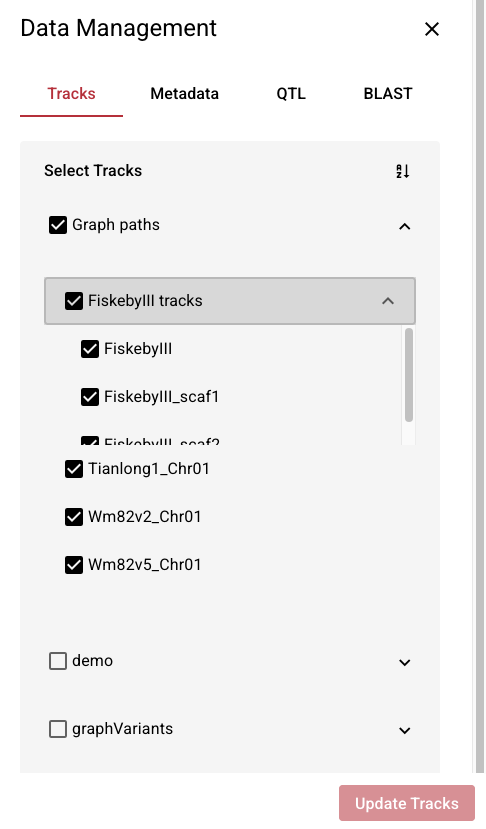
The Tracks Menu (titled "Data Management") is the single place where all data that can be displayed along the pangenome is selected. It is opened with the button in the Toolbar — or in the Genome Toolbar of the Genome View — and groups the selectable data into four tabs:
| Tab | Selects | Described in |
|---|---|---|
| Tracks | Graph path tracks and variant tracks | Graph tracks, Variant tracks |
| Metadata | The metadata categories shown as heatmaps in front of the tracks | Metadata |
| QTL | BED region tracks (typically QTL regions), one per trait | QTL regions |
| BLAST | Hits of finished BLAST pipelines | Explore BLAST hits |
INFO
In the Genome View only the QTL and BLAST tabs are shown, since graph path tracks, variant tracks and metadata are displayed in the Graph View only.
Tracks tab
The "Select Tracks" list holds one expandable group per track category:
- Graph paths: all graph tracks of the current chromosome. The checkbox next to the group title (de)selects all of them at once. Genomes contributing more than one sequence (e.g. scaffolds or contigs) form a nested subgroup named "genome name tracks" (e.g. "FiskebyIII tracks"): its first entry is the merged track of that genome, the following entries are its individual sequences.
- One group per variant data set (
demoandgraphVariantsin the screenshot): the variant tracks of that group. Summary variant tracks are collected in an own "Summary Tracks" group and marked with a small green circle.
The button in the top right of the list toggles how the tracks within a group are ordered: by name, or in the order in which they are displayed in the graph. The tooltip states the currently active order.
Changes are not applied immediately. The Update Tracks button at the bottom activates as soon as the selection differs from what is currently displayed; click it to load the new set of tracks.
INFO
If more than the maximum number of variant tracks is selected, Pantograph displays the summary variant tracks of the affected groups only, and notifies about it.
Metadata tab
Lists all metadata categories available for the project, each with a checkbox, plus an "All" checkbox to toggle all of them at once. Selected categories are shown as heatmaps in front of the tracks and can be used to sort the tracks. Changes take effect immediately.
QTL tab
Selects the traits whose QTL regions are loaded as BED region tracks, including the filters for QTL length and for QTLs based on genetic markers.
BLAST tab
Selects the BLAST pipelines whose hits are loaded as tracks, and offers the coloring, filtering, and Alignment View of their hits.
INFO
QTL traits and BLAST pipelines share a common display limit. A "maximum selection reached" note appears when the combined number of selected traits and pipelines reaches it.
Graph Setting Menu
The Graph Setting Menu controls how tracks are displayed in the graph: it allows adjusting label length and choosing how variant cells are colored.
Changes made in this panel are not applied immediately — they are staged locally. The Apply button at the bottom activates only when there is a pending change. Click it to apply all settings and redraw the graph.
General Settings: Track label length
Controls how many characters of each track label are shown in the graph. Use the slider or type a number directly into the input field. The value must be between 1 and the maximum determined by the current dataset.
Color Rules
Controls how variant cells in the graph are colored.
Select variable to color single variant cells
Determines how to color cells that contain exactly one variant. Available options:
| Option | Description |
|---|---|
| Genotype | Color by sample genotype (the darker, the more alternative alleles) |
| Variant type | Color by the type of variant (e.g. SNP, INDEL, SV) |
| Source | Color by genotype method (e.g. graph-based, reference-based) |
| Match multi-variant colors | Use the same color scheme as multi-variant cells (see below) |
Advanced settings (expandable): Multi-variant cells
Determines how to color cells containing multiple overlapping variants:
| Option | Description |
|---|---|
| Standard | Uniform coloring |
| Density | Color by the number of variants within a cell |
When Density is selected, a density threshold field appears. Enter a positive integer that defines the upper bound of the color scale — cells at or above this count are shown at maximum color intensity.